A geographic information system (GIS) integrates hardware, software, and data for capturing,
managing, analyzing, and displaying all forms of geographically referenced information. GIS
allows us to view, understand, question, interpret, and visualize data in many ways that
reveal relationships, patterns, and trends in the form of maps, globes, reports, and charts.
A geographic information system is any system that captures, stores, analyzes, manages, and
presents data that are linked to location. GIS technology can be used for remote sensing,
analyzes changes, scientific investigations, resource management, asset management, archaeology,
environmental impact assessment, urban planning, cartography, criminology, geographic history,
marketing, logistics, prospectively mapping, and many other purposes.
Definitions from ESRI and Wikipedia encyclopedia.
What is RS? A brief definition of Remote Sensing.
Remote Sensing (RS) is the process
of measuring spectral information collected from satellite and aerial based sensors to make
observations, take measurements, and produce images of phenomena that are beyond the limits
of our own senses and capabilities.
Objectives A quick summary of objectives & mission statement for the GIS division.
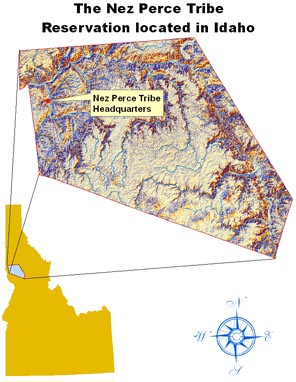
The Nez Perce Tribe's Geographic Information Systems (GIS) and Remote Sensing (RS) program
provides a computer-based solution used to collect, model, store, retrieve, share, manipulate,
analyze, and present geospatial and spatiotemporal data. The GIS/RS program's purpose is to synthesize, decipher,
and depict geospatial characteristics within the Nez Perce Tribe's territory
that is
pertinent to natural resource management planning.
The mission of the GIS/RS program is to provide a geographic information
foundation to support effective natural resources management. The
GIS/RS program will provide the technological vision and leadership to
deploy appropriate spatial technologies that will contribute towards an
improved ecosystem.
Nez Perce Tribe GIS Updates Servers New software training and meetings will be scheduled.
The Nez Perce Tribe's Geographic Information Systems (GIS) has just moved into ArcGIS Enterprise 10.9.1 and ArcPro 2.9
and continue to update ESRI software. If you have
questions or want a detailed explanation please contact
nptgis@nezperce.org
The current changes: Virtual Servers Data Locations Update to
ArcMap 10.9.1 Update to ArcPro Update to Portal

 A geographic information system (GIS) integrates hardware, software, and data for capturing,
managing, analyzing, and displaying all forms of geographically referenced information. GIS
allows us to view, understand, question, interpret, and visualize data in many ways that
reveal relationships, patterns, and trends in the form of maps, globes, reports, and charts.
A geographic information system is any system that captures, stores, analyzes, manages, and
presents data that are linked to location. GIS technology can be used for remote sensing,
analyzes changes, scientific investigations, resource management, asset management, archaeology,
environmental impact assessment, urban planning, cartography, criminology, geographic history,
marketing, logistics, prospectively mapping, and many other purposes.
A geographic information system (GIS) integrates hardware, software, and data for capturing,
managing, analyzing, and displaying all forms of geographically referenced information. GIS
allows us to view, understand, question, interpret, and visualize data in many ways that
reveal relationships, patterns, and trends in the form of maps, globes, reports, and charts.
A geographic information system is any system that captures, stores, analyzes, manages, and
presents data that are linked to location. GIS technology can be used for remote sensing,
analyzes changes, scientific investigations, resource management, asset management, archaeology,
environmental impact assessment, urban planning, cartography, criminology, geographic history,
marketing, logistics, prospectively mapping, and many other purposes.
 Remote Sensing (RS) is the process
of measuring spectral information collected from satellite and aerial based sensors to make
observations, take measurements, and produce images of phenomena that are beyond the limits
of our own senses and capabilities.
Remote Sensing (RS) is the process
of measuring spectral information collected from satellite and aerial based sensors to make
observations, take measurements, and produce images of phenomena that are beyond the limits
of our own senses and capabilities.